


SN74LS245N
SN74LS245N TI DIP-20
OCTAL BUS TRANSCEIVERS WITH 3-STATE OUTPUTS
Delivery
EXW
minimum order
10 pieces
Supply Ability
2800pieces / Day
Country of Origin
THAILAND
Stock Time
1-2Day
Quantity
SN74LS245N
OCTAL BUS TRANSCEIVERS WITH 3-STATE OUTPUTS
programming chip power ic
SN74LS245N Product details
The SN54/74LS245 is an Octal Bus Transmitter/Receiver designed for 8-line asynchronous 2-way data communication between data buses.
The SN54/74LS245 is an Octal Bus Transmitter/Receiver designed for 8-line asynchronous 2-way data communication between data buses.
Direction Input (DR) controls transmission of Data from bus A to bus B or us B to bus A depending upon its logic level. The Enable input (E) can be used to isolate the buses.
• Hysteresis Inputs to Improve Noise Immunity
• 2-Way Asynchronous Data Bus Communication
• Input Diodes Limit High-Speed Termination Effects
• ESD > 3500 Volts
Electronic components are the basic building blocks of electronic circuits and are used to construct
various circuits that enable electronic products to perform various functions. The following are common
electronic components and their main functions:
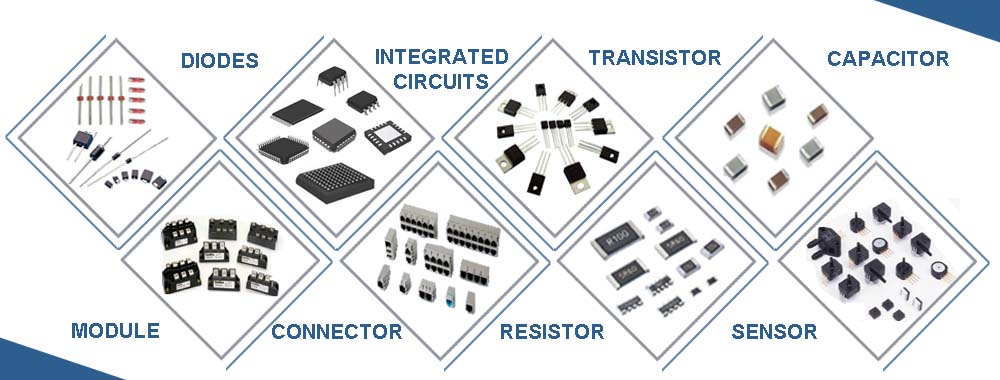
1. Capacitor: used for storing charge, smoothing voltage, filtering, delaying, etc.
2. Resistor: used for limiting current, changing voltage, dividing voltage, regulating current, etc.
3. Diode: used for rectification, voltage stabilization, switching, etc.
4. Transistors such as thyristors and triodes: used for signal amplification, current control, switching, etc.
5. Integrated circuits (ICs): integrate multiple electronic components to achieve complex circuit functions.
6. Sensors: convert various physical quantities into electrical signals, such as temperature, humidity, light intensity, pressure, etc.
Electronic components are widely used in various electronic products such as computers, mobile phones,
1. Capacitor: used for storing charge, smoothing voltage, filtering, delaying, etc.
2. Resistor: used for limiting current, changing voltage, dividing voltage, regulating current, etc.
3. Diode: used for rectification, voltage stabilization, switching, etc.
4. Transistors such as thyristors and triodes: used for signal amplification, current control, switching, etc.
5. Integrated circuits (ICs): integrate multiple electronic components to achieve complex circuit functions.
6. Sensors: convert various physical quantities into electrical signals, such as temperature, humidity, light intensity, pressure, etc.
Electronic components are widely used in various electronic products such as computers, mobile phones,
televisions, audio, automotive electronics and more. Their function is to transmit, process and convert signals in
the circuit to provide the foundation for electronic products to perform various functions.
Sharon Business Director